


Helping Business to Succeed
Dr Alan Morpeth AMDS Consultants Ltd
A simple framework for creating a high performing enterprise that: improves customer performance, increases profitability and creates empowered employees.
Why is it some companies will always be on the list of top performers for customer loyalty, employee satisfaction and high performance delivery while so many others fail to reach the public consciousness or market reputation in these critical components of a successful business?
In my career I have watched and been part of teams and enterprises that have succeeded: “against the odds”, beyond expectation or have simply failed to deliver leading to a negative impact on business performance, reputation or customer satisfaction. Now I am no longer a corporate apparatchik and the owner of a small business I’ve had the opportunity to consider what actually made the difference in all those years of struggle inside large, sclerotic, risk averse businesses.
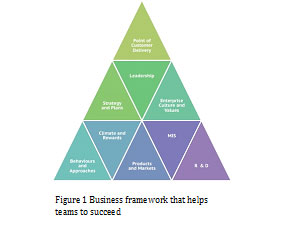 I have tried to encapsulate my experiences into a simple model, Figure 1.
The framework represents my personal view of how a successful enterprise should approach their operations to facilitate high performance, encourage employee empowerment and realise team success.
At the base of the pyramid are the five fundamental building blocks that must be in place to create the best possible environment for achievement. The fundamentals are enhanced by business philosophies in the key areas of strategy, culture and leadership. Both together achieve exceptional performance at the point of customer delivery. When employees can see and relate to such achievement then the enterprise has created an operational framework that encourages empowerment and realises high performance teams.
The base of the pyramid
To ensure the pyramid is not built on sand the enterprise must address:
- Behaviours and approaches within the business
- Working climate and reward structure
- Products and markets the business has and operates in
- Facilitative management information systems
- Investment in research and development.
Behaviours and approaches
So often spoken about and so rarely addressed except at the most superficial level. The High Performing Enterprise (HPE) needs behaviours throughout the business to be focussed on customer delivery and demands high standards of individual performance. The HPE should maintain a long-term management philosophy while striving for excellence at all levels in in all types of leadership. The focus on individual performance and leadership can be amplified by a team-orientated structure that encourages collaboration and cross-sector learning. Staff at all levels should be rewarded for exhibiting these behaviours whilst those who would protect their position, restrict information flow or undermine collaboration must be challenged. Ultimately the HPE should monitor lightly but intelligently giving freedom and flexibility but maintaining a structure and framework of operations all staff understand and have contributed too.
Management climate and reward structure
In the HPE climate and reward should be intimately connected. The enterprise must create and sustain a learning environment where risk taking and failure are accepted within a framework and subject to learning being captured and promulgated. The business must strive to achieve a practical balance between reward and recognition that encourages staff loyalty while ensuring that all employees are treated in an open and honest way. To enable the balance to be achieved the HPE must effectively manage both outstanding and poor performers at individual and team levels. Ultimately the management climate and reward structure should support an achievement-orientated business that delivers to customers.
Products and markets
Whether it’s in product manufacture or service provision operating in national or international market the HPE needs to constantly refresh its offerings to meet evolving customer needs and focus investment to ensure a continuously improving product or service portfolio. To facilitate evolution the enterprise seeks and gets feedback from both internal and external customers and this should lead to a wholly customer-centric approach to the business. Importantly the HPE should actively monitor and manage the relationship with it’s markets while striking the balance between markets for long-term needs as well as short-term gain.
Management Information Systems (MIS)
Critical to the HPE is access to management information appropriate to all levels of the organisation. MIS must be seen to facilitate performance not dictate data entry. The levels of access and quantity of information made available must be fit for purpose at each and every level within the business. By providing the right information at the right time with the appropriate level of detail the MIS should encourage staff commitment to its use. An important corollary to the availability of information is that it should be provided where it is needed not where it is demanded; so often the internal monitoring function of underperforming businesses will ask for information in their format not how it is provided within the enterprise’s value chain, this generates waste, frustration and “off-book” solutions to meet a functionary’s personal construct. Ultimately the HPE should be investing in a MIS that realises improvements in efficiency, economy and effectiveness whilst ensuring individual employees can access information that they need to perform.
Research and development (R&D)
The final fundamental of a HPE, one so often hidden in the closet, is R&D. Markets evolve, competitors arrive, products become dated or superseded, services fail to develop; all of these factors should drive the HPE towards investment in R&D. The HPE readily recognises the intrinsic value of a vibrant R&D portfolio. It ensures the R&D portfolio is part of the mainstream, providing high-level focus, resources for staff to pursue new ideas and has an active approach to exploitation of the outcomes of the portfolio. Ultimately a HPE must positively and flexibly manage it’s R&D portfolio to allow a rapid response to changing customer needs and market requirements. It should encourage staff to be innovative, challenge the status of existing products or services and ultimately offer employees the chance to make a difference with their insights and ideas.
The Philosophies of a HPE
In a HPE three philosophical constructs are essential to success, to be a HPE the enterprise:
- Must have a recognisable culture and a well publicised set of values
- Must develop, publicise widely and actively pursue strategies and plans
- Must provide appropriate, well-founded visionary leadership at all levels
In creating the “right” culture the HPE should develop and publish a set of core values that are understood within the business and have been developed in partnership with employees, customers, stakeholders and suppliers. The culture must be founded in continuous improvement and learning while employees are engaged both honestly and openly. To create the climate of continuous learning the HPE must have a philosophy of encouraging innovation, accepting that failures can happen but ensuring enterprise learning from both failure and success.
Critical to winning and sustaining staff commitment is the need for the HPE to engage with staff on the development of it’s strategies and plans. It is essential that these outputs are both accessible and actively pursued whilst performance measurement must be about more than money. The HPE should ensure that pursuit of enterprise strategies and plans are measured using both financial and non-financial metrics at all levels including team performance. Ultimately to become a HPE the business must evolve it’s strategic and tactical approach to focus on outcomes not inputs.
It is both obvious and regrettable that the validity of the business’ culture and values as well as the realism of it’s strategies and plans is nothing without an investment in leadership that is:
- Clear about and committed to realising a HPE
- Provided by those with the requisite skills, charisma and experience not those with merely longevity in post or job title
- Offers a lightness of touch, intensity of focus and is driven by a customer-led vision.
If a business can develop the fundamental building blocks described and demonstrate the philosophies discussed then it has gone a long way to becoming a HPE. All of these factors, when brought together, demand that the HPE:
- Realises high performance in customer delivery
- Harnesses the organisation’s capabilities to meet and exceed customer expectations
- Evolves a flexible, responsive and innovative enterprise capable of rapidly responding to changing customer needs and new market dynamics
- Seeks and gets feedback on customer performance and adapts to these findings rather than shelving them
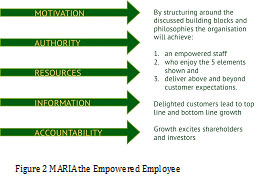
With improved performance at the point of delivery because of it’s approach to the preceding constructs the HPE should generate growth in top and bottom line profit.
If staff can see, feel and experience these changes then this will provide the motivation essential to high performance. If because the building blocks are in place and the organisation has developed the necessary philosophies the staff will also have the information and resources to deliver. Ultimately, because their contribution is valued and measured in a fair and equitable way, the staff will have the accountability and authority to contribute to the creation of the HPE. In this way the HPE has created MARIA the Empowered Employee, Figure 2
Related Post

SOFT SKILLS, HARD RESULTS
SOFT SKILLS, HARD RESULTS Married to Joya, an IT training and Learning & Development...

MANAGE PEOPLE PERSONALLY, NOT...
MANAGE PEOPLE PERSONALLY, NOT BY POLICY Over the past 15 years I have been engaged by a...

CAN MANAGERS BE LEADERS?
CAN MANAGERS BE LEADERS? We are still meeting people who use the terms “management”...

Leave a Comments